
Artificial intelligence is changing marketing fast. From the way businesses analyze customer behaviour to how people search for products and services, AI is becoming part of nearly every stage of the marketing journey.
But that raises an important question for businesses looking for marketing support:
What is the difference between an AI marketing agency and a traditional marketing agency?
The answer is not simply that one uses AI and the other does not.
Many marketing agencies now use AI tools in some capacity. The bigger difference is how deeply AI is integrated into the marketing strategy, decision-making, research, optimization and customer journey.
And despite the hype, AI does not make traditional marketing expertise obsolete. In many cases, the strongest approach combines both.
What Is a Traditional Marketing Agency?
A traditional digital marketing agency typically helps businesses attract customers, build brand awareness and generate leads through established marketing channels.
Depending on the agency, services may include:
- Search Engine Optimization (SEO)
- Google Ads and paid media
- Social media marketing
- Content marketing
- Email marketing
- Website design and development
- Branding and creative
- Analytics and reporting
These services remain extremely important.
Customers still search Google. They still visit websites, click ads, read reviews, open emails and interact with brands on social media.
What is changing is how those activities can be researched, executed, measured and optimized with AI, and how customers themselves are using AI to discover businesses.
That is where an AI-focused marketing agency begins to look different.
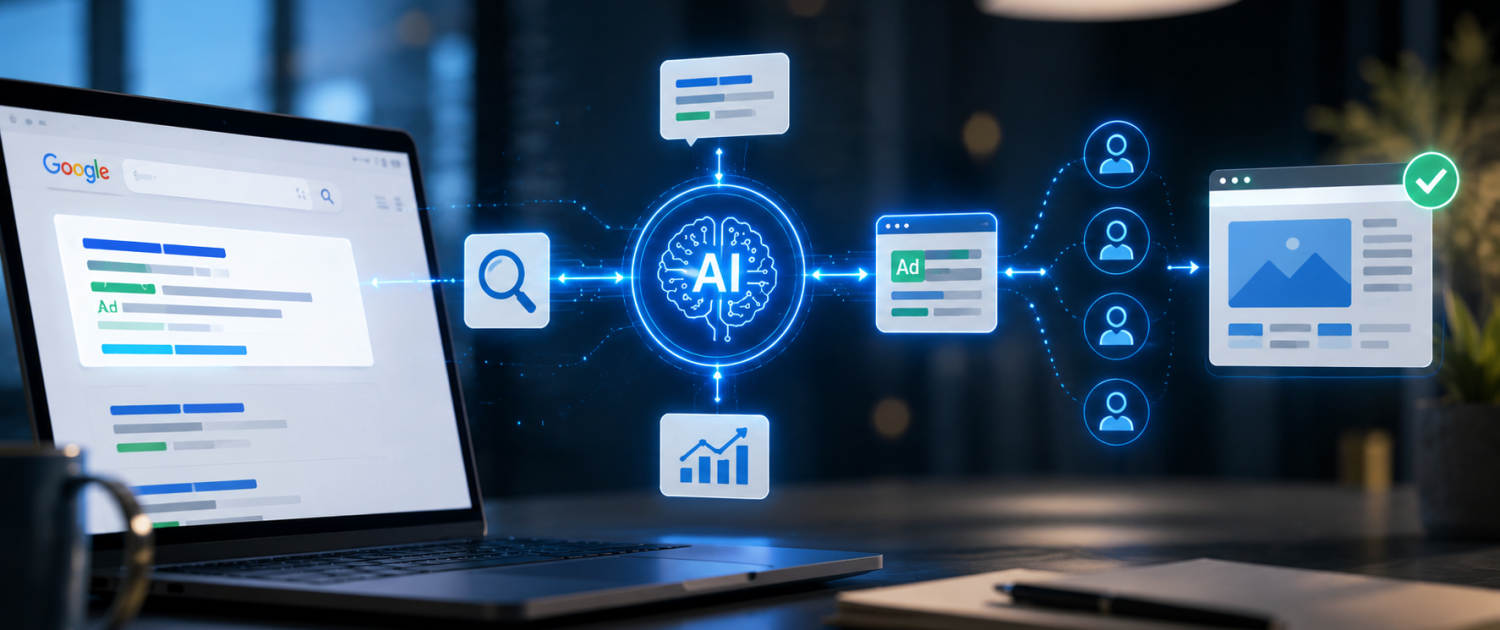
What Is an AI Marketing Agency?
An AI marketing agency integrates artificial intelligence into its broader marketing strategy to help businesses work with larger amounts of information, identify opportunities faster, automate appropriate processes and adapt to new ways customers search and make decisions.
That can include using AI for:
- Marketing and competitor research
- Data analysis
- Content research and optimization
- Search intent analysis
- Campaign insights
- Workflow automation
- Audience and customer insights
- SEO research
- AI search visibility
- Answer Engine Optimization (AEO)
- Large Language Model Optimization (LLMO)
But there is an important distinction.
Using ChatGPT to write a blog post does not make a company an AI marketing agency.
The real value comes from knowing where AI belongs in a marketing strategy, where it does not, and how to combine its capabilities with human experience, creativity and judgment.
AI Marketing Agency vs. Traditional Marketing Agency: Key Differences
The easiest way to understand the difference is to look at how each approach handles common areas of marketing.
1. Research and Data Analysis
Traditional marketing research can involve reviewing analytics, competitors, keyword data, customer behaviour and industry trends manually across multiple platforms.
AI can help marketers process and organize much larger amounts of information and identify patterns or opportunities more efficiently.
That does not mean handing strategic decisions over to an algorithm.
It means giving experienced marketers better tools to ask questions, analyze information and make informed decisions.
2. SEO and AI Search Visibility
Traditional SEO focuses heavily on helping businesses become more visible in search engines such as Google.
That is still essential.
However, customers are increasingly discovering companies through AI-powered search experiences and assistants as well.
Someone looking for a service may no longer search only:
“best window company near me”
They might ask an AI platform:
“What are some reputable window companies in my area that manufacture and install their own windows?”
Those are very different search experiences.
An AI-aware marketing strategy therefore considers not only traditional search rankings, but also whether a company’s website, content, brand signals and online presence make the business easy for AI systems to understand and potentially reference.
This is where areas such as AEO, LLMO and AI search optimization are becoming increasingly relevant.

3. Content Creation vs. Content Intelligence
Generative AI has made creating content remarkably easy.
Creating good content is another matter.
Publishing dozens of AI-generated articles without strategy, expertise or quality control can result in generic content that sounds remarkably similar to everything else online.
An AI marketing agency should not simply produce more content because AI makes production faster.
Instead, AI can assist with research, topic discovery, content gaps, search intent, structure and optimization while human expertise shapes the final message.
The objective is not:
How much content can AI create?
The better question is:
What content will actually help our audience and our business?
4. Marketing Automation
Automation existed long before generative AI, but AI is expanding what businesses can automate and how intelligently those systems can operate.
Depending on the business and technology involved, AI-assisted workflows can help with tasks such as:
- Organizing and analyzing marketing data
- Identifying patterns in campaign performance
- Categorizing leads or customer information
- Assisting with reporting
- Personalizing certain marketing experiences
- Streamlining repetitive internal processes
The goal should not be to automate everything.
Good automation removes unnecessary manual work while keeping human involvement where judgment, creativity or customer relationships matter.
5. Campaign Optimization
Traditional digital campaigns are already highly data-driven.
AI adds another layer by helping marketers analyze performance information faster and identify patterns that may be difficult to spot manually.
But AI-generated recommendations still require context.
A platform may identify what happened.
An experienced marketer needs to determine why it happened, whether it matters and what the business should do next.
That distinction is critical.

6. Personalization
Traditional marketing often creates campaigns around broader audience segments.
AI can make it possible to analyze customer signals at greater scale and support more personalized experiences.
However, personalization needs to be useful rather than intrusive.
Knowing more about an audience does not automatically create better marketing. The information still needs to translate into a relevant message, offer or experience.
Does an AI Marketing Agency Still Do SEO?
Absolutely.
AI search is not replacing traditional search overnight.
Google remains an important part of how customers research businesses, products and services, while websites continue to play a central role in establishing credibility and converting interest into leads.
The difference is that SEO strategy now needs to consider a broader search environment.
Businesses increasingly need content that works for:
- Traditional search engines
- AI-powered search experiences
- Potential customers
- Search crawlers
- Large language models
The fundamentals still matter: technically sound websites, useful content, authority, clear information, strong local signals and a good user experience.
AI adds another layer to that strategy rather than eliminating it.
What About Google Ads, Social Media and Web Design?
They still matter too.
One of the biggest misconceptions surrounding AI marketing is that every established marketing channel is suddenly outdated.
It isn’t.
A beautifully designed website still matters when someone evaluates your company.
Google Ads can still put a business in front of customers with immediate purchase intent.
Social media still builds awareness and gives brands a way to communicate with their audience.
SEO still creates long-term organic visibility.
What AI changes is the intelligence surrounding those activities.
It can help marketers research faster, interpret data, identify opportunities and create more efficient workflows.
The channel is not necessarily changing.
The capabilities behind it are.
Where Human Marketing Expertise Still Matters
AI can generate ideas in seconds.
It can analyze information, summarize research, recognize patterns and automate tasks that previously consumed hours.
What it cannot do independently is understand every nuance of a business, its customers, its reputation, its history and where it wants to go.
Successful marketing still requires human judgment.
Marketers need to determine:
- What makes the business genuinely different
- Which customers are worth pursuing
- How the brand should communicate
- Which opportunities align with business goals
- When data is misleading
- Whether AI-generated information is accurate
- When automation improves the experience and when it hurts it
AI can make marketers more capable.
It does not eliminate the need for marketing expertise.
Is AI Replacing Digital Marketing Agencies?
AI is more likely to change what businesses should expect from their marketing agency than eliminate the need for one.
The value of an agency can no longer come simply from completing tasks that AI tools can perform in seconds.
Businesses need strategy, interpretation, creative thinking, technical expertise and the ability to connect different marketing channels to measurable business goals.
That means the role of an agency is evolving.
The question is shifting from:
“Can you create this for us?”
to:
“Can you help us determine what we should be doing, why we should be doing it and how technology can help us do it better?”
Which Type of Marketing Agency Is Right for Your Business?
Choosing between a traditional agency and an AI-focused marketing agency should not come down to which company mentions AI most often on its website.
Instead, look at how the agency thinks.
Ask questions such as:
- How is AI actually incorporated into your marketing strategy?
- How are you adapting SEO for AI-powered search?
- How do you verify AI-generated research and content?
- Which parts of your process are automated?
- Where are humans still involved?
- How do you connect AI initiatives to measurable marketing goals?
- How do SEO, paid advertising, content, web development and AI work together?
A strong agency should be able to explain its approach without hiding behind AI terminology.
The Best Approach Isn’t AI vs. Traditional Marketing
Ultimately, businesses should not have to choose between traditional marketing expertise and AI.
They need both.
SEO, paid advertising, branding, web development, content and creative strategy provide the marketing foundation.
AI can make that foundation more intelligent, efficient and adaptable.
The opportunity is not to replace proven marketing principles with artificial intelligence.
It is to use AI to make good marketing better.
Marketing Strategy Built for How People Search Today
At A&G Creative Group, we believe technology should strengthen marketing strategy, not replace it.
As search behaviour evolves and AI becomes a bigger part of how customers research businesses, marketing strategies need to evolve with it.
That means looking beyond individual channels and understanding how SEO, AI search visibility, content, advertising, web development, creative and data work together to move a business forward.
Want to find out where AI could fit into your marketing strategy? Contact A&G Creative Group to start the conversation.

Frequently Asked Questions
What is an AI marketing agency?
An AI marketing agency incorporates artificial intelligence into areas such as research, analytics, content optimization, automation, campaign insights and AI search visibility while using marketing expertise to guide strategy and decision-making.
What is the difference between AI marketing and digital marketing?
Digital marketing refers broadly to marketing through online channels such as search engines, websites, social media, email and digital advertising. AI marketing uses artificial intelligence to enhance aspects of those activities through analysis, automation, personalization, research and optimization.
Does using AI make an agency an AI marketing agency?
Not necessarily. Using generative AI tools for isolated tasks is different from integrating AI into research, strategy, analytics, optimization and workflows across a marketing program.
Will AI replace traditional marketing?
AI is changing how marketing work is performed, but core marketing principles such as understanding customers, positioning a brand, developing strategy, creating compelling ideas and building trust remain important. AI is better viewed as an additional capability rather than a replacement for marketing fundamentals.
Is SEO still important with AI search?
Yes. Traditional search remains an important discovery channel, and many of the signals that make a business understandable and authoritative online are also relevant in an AI-driven search environment. Businesses should consider both traditional SEO and emerging AI search visibility.
How can a business improve its visibility in AI search?
Clear website structure, authoritative and useful content, consistent business information, strong brand signals and content that directly answers customer questions can all contribute to a stronger digital presence.
AI visibility should be approached as part of a broader SEO, content and brand strategy rather than as a standalone tactic.
Ready to start exploring your brand story?

